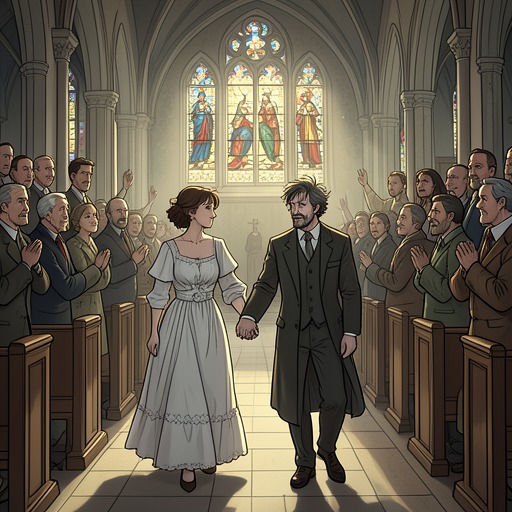
Chicago City Hall
The Time Traveler's WifeChicago City Hall is where Henry DeTamble and Clare Abshire are married by a judge on October 25, 1993. The brief civic ceremony gives legal form to a partnership whose chronology has never been shared evenly: for Henry and Clare, a wedding is both a present commitment and one point in a life repeatedly interrupted by time travel.
Setting and Civil Ceremony
The Monday after their wedding, Henry and Clare return to Chicago City Hall and are married by a judge. The scene is narrated by Henry, who locates the ceremony in the ordinary civic setting of City Hall rather than in a church or a private family home. Its plain institutional character gives the marriage a public, legal form.
Gomez and Charisse serve as witnesses. Their presence connects the ceremony to the couple’s circle of friends, while the judge’s role makes the marriage an official act. The distinction between the wedding and this City Hall ceremony matters: the latter is the moment Henry identifies as the marriage itself.
Celebration and Confirmation
Afterward, the four go to dinner at Charlie Trotter’s. Henry describes the restaurant as so expensive that its decor suggests either an airplane’s first-class section or minimalist sculpture; although the food looks like art, he finds that it tastes good. Charisse photographs each course, turning the meal into a record of the occasion.
When Charisse asks Henry how being married feels, the exchange gives the formal event a personal coda. Gomez mutters about Zen koans, while Clare smiles and raises her glass. Henry taps her glass with his, and its delicate note briefly rings through the restaurant. He then states, “And so, we are married.” The declaration closes the scene with a simple fact after the ceremony and celebration have made it tangible.
Narrative Significance
The City Hall ceremony is a decisive point in the couple’s relationship, but the novel does not treat marriage as a guarantee of continuous shared time. The surrounding narrative moves among dates and ages that do not align in the same order for Henry and Clare; the wedding’s firm legal and social recognition therefore stands in contrast to the instability of their lived chronology.
The scene also gives marriage a communal dimension. Gomez and Charisse witness the legal act and share the dinner afterward, while Clare and Henry’s exchanged smile and raised glasses center the commitment on the couple. City Hall thus anchors an extraordinary relationship in an ordinary civic ritual: a judge marries them, friends witness it, and Henry names the result.